

|
|
|
|
|
|
||
|
|
|
|
|
|
||
|
Prime Rate |
Current Prime Rate | Prime
Rate History | Prime
Rate Forecast | SITEMAP Prime Rate Chart | Credit Card Search | Economy | Life Insurance | LIBOR Rates MONTHLY Prime Rate History | United States Prime Rate Flow Chart | Mortgage Rates |
||
|
|
||
| Can A Presidential Election Change The Prime Rate? | ||
|
|
||

|
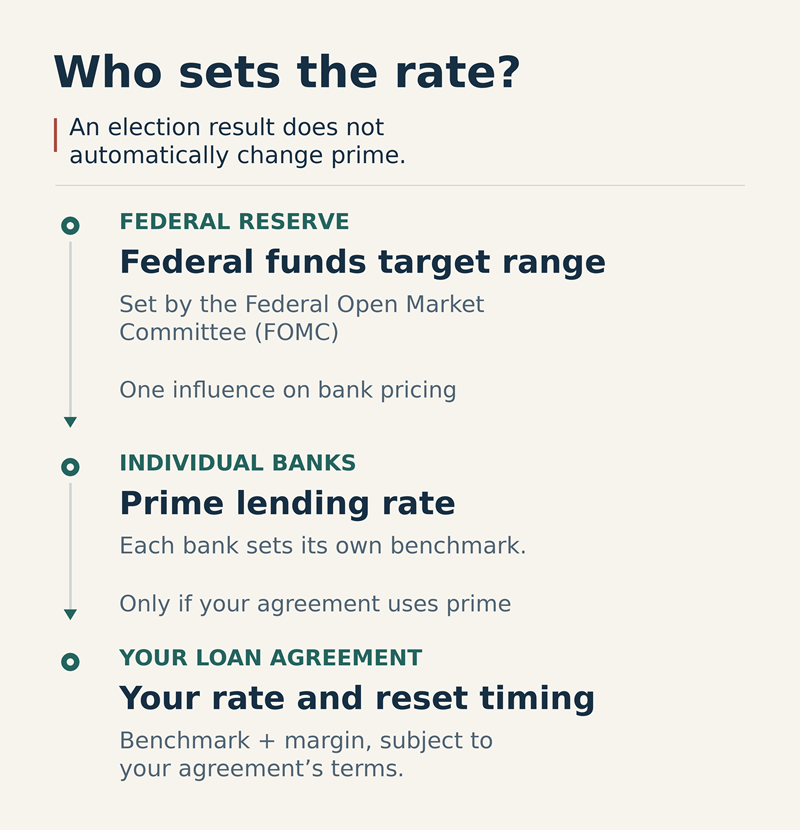
A presidential election can influence the policies and appointments that shape economic conditions. It does not automatically change the prime rate. Individual banks establish that benchmark, while the Federal Reserve makes monetary-policy decisions that influence short-term borrowing costs. For anyone following the interest charged on a credit card or small-business loan, the useful distinction is between a political development that changes expectations and a lending decision that changes the rate used in their existing agreement. Presidents can influence the Federal Reserve through appointments, but that influence operates within a larger decision-making structure. Rathbones' explanation of central-bank independence describes why monetary policy is separated from the short-term incentives of electoral politics. An administration may favor lower interest rates, yet officials responsible for monetary policy must weigh economic conditions. A campaign promise to make borrowing cheaper therefore leaves several decisions unresolved, including what the central bank will do and how lenders will price credit. Presidential election odds set out the terms of a wager on an electoral outcome. They address who wins the contest. Connecting that expected result to borrowing costs requires further judgments about which policies will take effect, how the economy will develop, and how monetary policymakers will respond. A clearer view of the likely winner can coexist with uncertainty about interest rates. Inflation or employment data released after the election may alter the economic outlook, even if expectations about the incoming administration’s policies remain unchanged. Election Day and the start of a presidential term are separate dates. The guide to the 2028 presidential election identifies November 7, 2028, as Election Day and January 20, 2029, as the inauguration date. During the intervening months, economic releases continue, and the Federal Reserve can make further policy decisions. A change in prime during that interval still comes from the bank setting the benchmark, rather than automatically following the election result. Who makes the interest-rate decisions? The Federal Open Market Committee, usually called the FOMC, sets the target range for the federal funds rate. This concerns overnight lending between banks and influences broader credit conditions. The committee makes monetary-policy decisions in pursuit of maximum employment and stable prices. Its assessment draws on economic information, so employment and inflation developments remain relevant, regardless of which party holds the presidency. Presidents nominate members of the Federal Reserve’s Board of Governors, subject to Senate confirmation. Governors serve staggered terms, and monetary policy is decided collectively by a committee that also includes regional Reserve Bank presidents. Electing a president does not replace that entire group. Even the Fed chair participates in a committee decision rather than personally setting every interest rate across the economy. An election can still affect the economic outlook through tax and spending policy, which the administration and Congress determine. The FOMC considers how those policies may influence growth, employment, and inflation when assessing monetary policy. This is an indirect connection: the economic effects enter the committee’s assessment alongside other developments. A president’s preferred policy and the interest-rate response are separate decisions, even when the first helps explain the second. Banks then make their own prime-rate decisions. Many base prime partly on the federal funds target, which explains the close relationship between the two benchmarks. Prime remains a bank lending reference, however, and banks use it to price some loans. Funding costs also influence banks’ lending decisions. A borrower’s actual rate can sit above or below prime. Reading a prime-rate headline as the rate available on every loan would miss that separate pricing decision.
ALT text: How Fed
decisions influence bank prime rates and reach borrowers through loan
agreements What an actual prime-rate change looks like On September 16, 2026, Fifth Third Bank announced an increase in its prime lending rate to 7.00%, effective immediately. Its announcement identified the previous change as December 10, 2025, when the bank had reduced prime from 7.00% to 6.75%. The September increase was therefore 0.25 percentage points, commonly described as 25 basis points. That announcement supplies details an election result cannot: the institution making the change, the benchmark affected, the new rate, and its effective date. It establishes what happened to that bank’s prime rate. It does not establish that every customer immediately began paying 7.00%, because individual borrowing agreements determine how a benchmark applies. Follow the benchmark in your agreement For an existing loan, start with whether the interest rate is fixed or variable. A fixed rate does not reset simply because prime moves. With a variable rate, identify the reference benchmark and the margin, meaning the amount added to that benchmark. The agreement should also explain when changes are applied. A bank’s announcement date and the date a change reaches a particular account are different details to check. Also check the exact benchmark named in the agreement. A reference to a published prime rate identifies which rate to follow; a general headline about interest rates may describe a different benchmark. Keep the benchmark change separate from the size of a payment change. The interest charged also depends on the balance and the period over which interest accrues. Knowing that prime moved by a quarter of a percentae point does not, by itself, establish the dollar difference on a statement. Political developments can help explain expectations about the economy. To understand an actual change in borrowing costs, follow the relevant policy decision, the bank’s benchmark announcement, and the terms of the account. The decisive question is which of those has changed and when that change applies to the borrowing agreement. |
|
|
|
||
 |
||
|
Prime Rate | Current Prime Rate | Prime Rate History MONTHLY Prime Rate History | Prime Rate Forecast | SITEMAP Prime Rate Chart | Life Insurance | LIBOR Rates Fed Funds | Prime Rate FAQ | International Prime Rates MONTHLY Prime Rate | Mortgage Rates | ! - Deceptive Websites - ! Latest Norton Antivirus Protection Renewal Scam In My Email Inbox My Uncle Got Sucked Into A "Home Depot" Phishing Scam QUESTIONS & COMMENTS | New York City Rent Is Too High! United States Prime Rate Flow Chart | Certificates of Deposit | WOLOF | Prime Rate Chart | ! - SCAMS - ! | ! - SCAM - ! |
||
Click Here to Jump to The Top of This Document |
||

Entire Website copyright © 2026 - FedPrimeRate.comSM, et. al. |
||