

|
|
|
|
|
|
||
|
|
|
|
|
|
||
|
Prime Rate |
Current Prime Rate | Prime
Rate History |
||
|
|
||
| What Casino Demand Data Can Show Beyond Consumer Confidence | ||
|
|
||

|
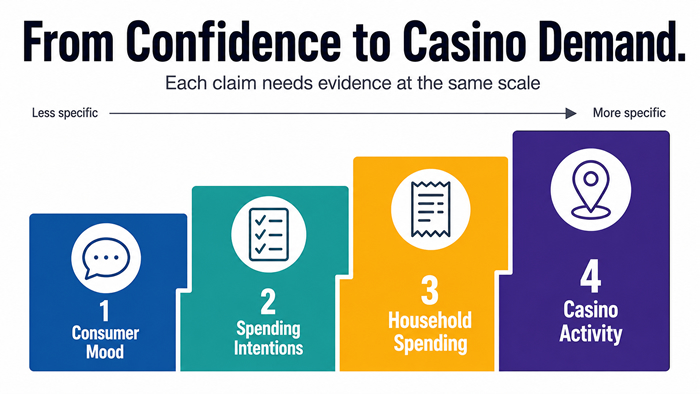
A consumer-confidence index can show whether households feel more secure or uneasy about the economy. It cannot reveal, on its own, whether people spent more on dining, travel, streaming, or casino entertainment. The missing step is specificity. A national survey measures attitudes across millions of households, while casino demand concerns behavior within one discretionary category. To judge whether the two moved together, a reader has to move from broad sentiment to intentions, recorded spending, and finally, evidence tied to the category being discussed. That is supported by research showing that sentiment and consumption respond to wider economic conditions. A study covering 28 European Union countries during December 2019 through October 2020 found that economic growth and inflation significantly shaped both economic sentiment and household consumption, although their relative effects differed. The study does not establish a universal rule for the United States or for casino activity, but it does show why confidence should be read as one signal formed alongside prices, employment, income, and broader economic change, rather than as a direct receipt for household spending. Four Levels of Evidence
Consumer confidence becomes most useful when its limits are made explicit. A movement in a headline index may indicate that households feel more or less secure, but it does not show which purchases changed, whether stated intentions became actual spending, or how any one entertainment category performed. Those questions sit at different levels of evidence. Separating them prevents a broad national signal from being stretched into a narrow conclusion it cannot support. The first level is headline sentiment: what respondents say about present conditions and the months ahead. The second is purchase intention, which asks whether people expect to spend money on a particular type of activity. The third is hard household expenditure, where reported consumption shows what was bought in aggregate. Only the fourth level reaches category or destination activity, and every step requires evidence that matches the narrower claim. A confidence reading might justify asking whether discretionary entertainment is weakening, but it cannot tell us what happened at https://thunderpick.io/casino or at any other individual casino destination. That would require independently measured participation or transaction data covering the relevant period. The same limit applies when an online casino appears in a discussion of demand: the destination belongs to the category under examination, but its existence is not evidence that national sentiment translated into more or less activity. The inference must stop whenever the claim becomes more specific than the data behind it. Headline confidence can therefore frame a hypothesis, while purchase intentions can make that hypothesis more specific. Hard spending data can test whether household behavior moved in the expected direction. Category data are still needed before drawing a conclusion about casino demand. Skipping a level may produce a neat story, but it also hides the point at which evidence gave way to assumption. The ladder is useful because it does not demand that every indicator move together. It asks only that each conclusion be supported at the level where it is stated. What Category Data Can Establish Suppose confidence falls during a month in which total consumer spending rises. That is not necessarily contradictory. Essential costs may have increased, some households may have maintained discretionary purchases, or survey respondents may have expressed concern without changing their immediate plans. Aggregate spending also combines many categories, so growth in housing, health care, or gasoline can conceal weaker leisure spending. A useful casino-demand measure would need a defined subject and denominator. Industry revenue, active users, visits, session frequency, and transaction value answer different questions. A rise in one does not automatically imply a rise in another. The dates also need to align. A survey collected early in a month, a quarterly expenditure release, and a short burst of destination activity may describe different periods. Analysts should first identify who was measured, what behavior was recorded, and when it occurred. They should also separate a change in the number of participants from a change in spending among existing participants. Both can move total activity, but they describe different responses to economic conditions. Why the Survey Question Matters Not every confidence question has the same connection to spending. A July 2026 Rabobank analysis found that, in its Dutch model, the measure asking whether it was a good time for large purchases outperformed the headline confidence index in explaining near-term household consumption. The researchers also noted important limits, including assumptions in the model and the possibility that the result reflects Dutch economic conditions rather than a universal relationship. That finding does not show that purchase-intention questions predict casino activity. It shows that wording and distance from the eventual decision matter. A question about making a purchase now is closer to behavior than a broad judgment about the national economy, yet it still concerns what respondents say rather than what a specific entertainment category records. Where the Inference Should Stop Consumer confidence is best treated as an opening signal. It can identify a change in mood and suggest which spending data deserve attention next. It cannot replace evidence of actual household purchases, and aggregate consumption cannot replace evidence from the particular leisure category being discussed. Before making a claim about casino demand, match the scale, dates, population, and behavior in the evidence to the scale of the conclusion.
|
|
|
|
||
 |
||
|
Prime Rate | Current Prime Rate | Prime Rate History MONTHLY Prime Rate History | Prime Rate Forecast | SITEMAP Prime Rate Chart | Life Insurance | LIBOR Rates Fed Funds | Prime Rate FAQ | International Prime Rates MONTHLY Prime Rate | Mortgage Rates | ! - Deceptive Websites - ! Latest Norton Antivirus Protection Renewal Scam In My Email Inbox My Uncle Got Sucked Into A "Home Depot" Phishing Scam QUESTIONS & COMMENTS | New York City Rent Is Too High! United States Prime Rate Flow Chart | Certificates of Deposit | WOLOF | Prime Rate Chart | ! - SCAMS - ! | ! - SCAM - ! |
||
Click Here to Jump to The Top of This Document |
||

Entire Website copyright © 2026 - FedPrimeRate.comSM, et. al. |
||